
Most AI Startups Won't Survive 18 Months. Here's Where the Real Money Actually Is.

Updated: Jul 15
Everyone is chasing the conventional model. Smart capital is chasing the infrastructure underneath it. Don't chase the wrong dog.
A breakdown of the 7 tiers of AI economics and where serious investors should be paying attention.
There is a version of the AI investment story that gets told constantly. It involves foundation models, large language interfaces, AI-native apps, and the race to build the next Chatgpt.
Most AI startups being built right now will not exist in 18 months. The application layer is crowded, commoditizing, and brutally competitive. Margins are thin. Differentiation is temporary. The capital flowing into that layer will produce a handful of winners and a long list of failures. The more durable opportunity sits underneath it.
Where AI Economics Actually Flow
To understand where value accrues, you have to break AI into layers.
Not all layers are created equal. Some are visible and crowded. Others are constrained and quietly compounding. The capital that lasts is not chasing visibility. It is positioning around constraint.
During the California Gold Rush of 1849, most miners chased the promise of striking gold but left with little to show for it. The real, consistent profits were made by those selling the picks, shovels, and wheelbarrows—tools every miner needed regardless of success or failure. In the same way, the most durable returns in AI are not coming from those chasing the breakthrough model, but from those building and supplying the infrastructure that every participant depends on.

Tier 1: Energy Infrastructure
AI does not run on code. It runs on electricity.
Data centers are projected to consume more energy than entire countries by 2030. Hyperscalers are already in an arms race for power capacity, and the gap between demand and available supply is widening faster than the grid can respond.
This is driving unprecedented demand for grid infrastructure, backup generation, fuel systems, and energy services. The real question is not who is building the data center. It is who is powering the power.
That includes utilities, generator manufacturers, fuel cell companies, and specialized service operators embedded in critical infrastructure ecosystems. The constraint on AI growth is power, not demand. That constraint is where durable, long-cycle value is being created.
Tier 2: Chips and Semiconductor Infrastructure
Nvidia's dominance is well understood. What is less discussed is everything required to support fabrication at scale.
A $10 billion semiconductor fab depends on cleanrooms, precision HVAC systems, HEPA filtration, and continuous maintenance. Large contractors build these facilities, but they do not want to manage routine operational complexity. That gap is a business.
Specialized operators that maintain mission-critical environments become deeply embedded and extraordinarily difficult to replace. Switching costs are high. Relationships are sticky. You do not need to build the fab to profit from it. You need to be the operator the fab cannot function without.
Tier 3: Data Centers
Capital is flowing into data centers at a pace the physical world is struggling to keep up with. Every facility requires a full stack of physical services — electrical systems, cooling infrastructure, fire suppression, cabling, structural maintenance, and ongoing inspection.

This is the picks-and-shovels layer of AI. Specialized operators command premium economics because the cost of failure is catastrophic and the tolerance for disruption is zero.
The best operators do not stay vendors. They enter as service providers and evolve into critical risk partners — embedded in operations, trusted with uptime, and difficult to displace.
Tier 4: Foundation Models
This is where the largest players compete. Open AI, Google, Anthropic, Meta and XAI are deploying billions to train and scale the models that power everything above this layer. The competitive dynamics are intense and still unsettled.
For most investors, this is not an efficient entry point. Valuations reflect optimism, and margin durability remains uncertain. The more durable opportunity sits adjacent to this layer. Infrastructure providers supplying compute, storage, and networking capture value regardless of which model ultimately wins.
The more durable opportunity sits adjacent. Infrastructure providers suppling compute, storage and networking capture value regardless of which model ultimately wins.
Tier 5: AI Software Infrastructure Platforms and Tooling
This layer enables developers and enterprises to build on top of foundation models — APIs, orchestration layers, middleware, and development environments that define how software is now created and deployed.
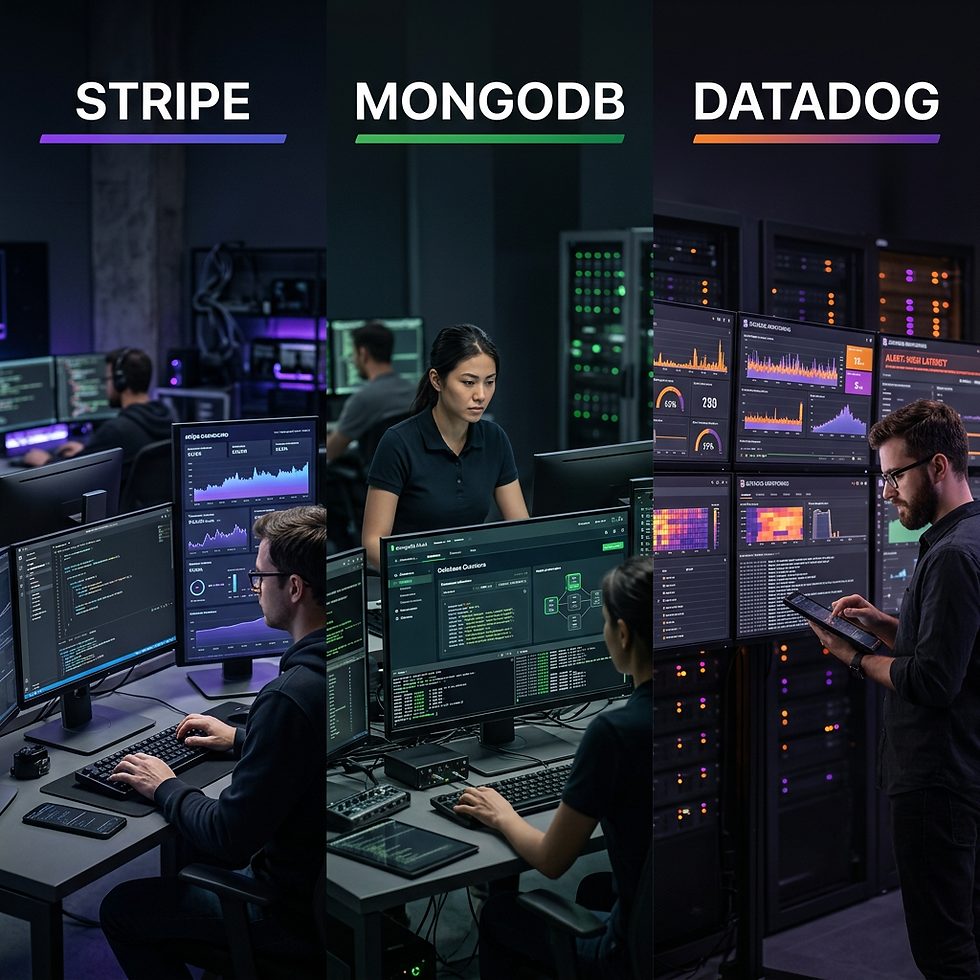
Think Stripe, MongoDB, or Datadog — unglamorous infrastructure that quietly became worth billions because everything else depended on it. Owning the interface layer creates durable leverage. These platforms become embedded into how products are built, not just what they do. That embeddedness is the moat.
Tier 6: AI Native Applications
This is the most crowded and competitive layer in the stack. Thousands of companies are building AI-driven applications across every vertical. Most will not survive.
The winners will have defensible distribution, proprietary data, or deep workflow integration that creates genuine switching costs. Without those advantages, differentiation erodes quickly as foundation models improve and commoditize capabilities.
This layer requires venture-style thinking — many bets, a few big outcomes. Entry costs are low. Competition is fierce. The base rate is unforgiving.
Tier 7: AI-Enabled Services Businesses
This tier receives almost no attention. That is precisely where the opportunity is.
Small and mid-sized businesses across every industry are filled with inefficiencies that AI can now solve — but most lack the internal capability to implement solutions. The operator who walks in, diagnoses the bottleneck, deploys a tailored solution, and becomes an ongoing partner builds something genuinely durable.
This is not venture-scale. It is a services model with real demand, low competition at the local level, and compounding customer relationships. The moat deepens over time as the operator accumulates proprietary knowledge of each client's operations.
And as AI implementation compounds operational value, these businesses become attractive acquisition targets — for larger operators, roll-up strategies, and private equity looking for proven, cash-flowing assets with embedded technology upside.
What Serious Capital Should Understand
The AI narrative is dominated by what is visible. Applications are easy to understand. Foundation models make headlines. Infrastructure does not. But infrastructure is where durability lives. Power, chips, data centers, and specialized services are not optional inputs. They are constraints. And constraints create pricing power.
The question is not which AI company wins. It is who gets paid regardless of which one does.
Where Eliakim Capital Fits
Eliakim Capital is focused on the infrastructure layers that AI depends on to function.
That includes power-constrained projects, data center development, and the operational stack that supports large-scale compute.
Working closely with Data Power Supply, Eliakim operates at the intersection of capital strategy and physical energy infrastructure. This is where the real bottlenecks are emerging. It is also where the most durable opportunities are being built.

Closing Insight
AI will not be limited by model capability. It will be limited by power, infrastructure, and execution. The capital that understands this will not chase the narrative.
It will position around the constraint. That is where the real value is.
About the Author
Todd Colpron is Managing Partner of Eliakim Capital which is a private investment and strategic advisory firm that manages its own capital while working alongside select family offices and private investors to identify and support exceptional opportunities.


Comments