
From Discovery to Philanthropy: How Indianapolis Helped Shape the Modern Biologics Revolution

Updated: Aug 25

Scientific breakthroughs often change medicine. Occasionally, they also reshape economies, create entirely new industries, and generate wealth that benefits society for generations.
Few places illustrate that better than Indianapolis.
For more than a century, the city has quietly stood at the forefront of biologics innovation, producing discoveries that have transformed the treatment of diabetes, depression, obesity, and countless other diseases.
Along the way, those scientific advances have generated more than $100 billion in economic value, fueled new companies, strengthened research institutions, and helped build one of the largest philanthropic foundations in the world.
This is the story of how a city built an enduring life sciences ecosystem, one breakthrough at a time.
A Scientist's Journey
Richard DiMarchi earned his PhD from Indiana University in 1979 before completing postdoctoral training under Nobel Prize winning chemist Bruce Merrifield at Rockefeller University, whose pioneering work in peptide synthesis helped shape modern biotechnology.
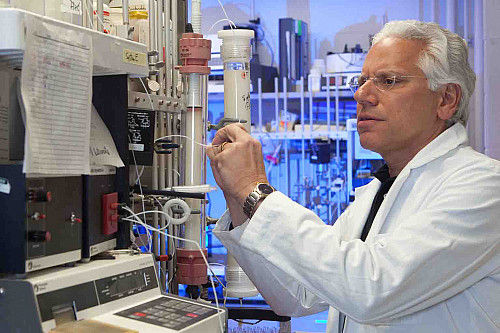
DiMarchi brought that expertise to Eli Lilly and Company in Indianapolis, where he spent more than two decades helping advance peptide science and ultimately became Vice President of Research and Development.
Among his many contributions was the development of Humalog, a rapid acting insulin analog that transformed diabetes care. By carefully redesigning the insulin molecule, DiMarchi and his colleagues created a therapy that acted more quickly than previous insulin formulations, giving patients greater flexibility around meals while improving glucose management.
More broadly, Lilly's long standing investment in peptide research helped establish one of the world's deepest concentrations of scientific expertise, creating an environment that trained generations of researchers who would go on to make important contributions throughout academia and industry.
A Discovery Ahead of Its Time
During his years at Lilly, DiMarchi collaborated with the late Suad Efendic of Sweden's Karolinska Institute to study a hormone known as GLP-1.
Their research revealed that GLP-1 therapies could do something unexpected: help overweight patients with diabetes lose weight while improving blood sugar control. Today, that observation is widely recognized as one of the foundational scientific advances behind the modern GLP-1 class of medicines.
At the time, however, the broader pharmaceutical industry had not yet recognized the full potential of this approach. Obesity was not widely viewed as a chronic disease, weekly injectable therapies represented an unfamiliar treatment model, and many of the underlying scientific and manufacturing challenges remained to be solved.
Like many transformative discoveries, the science arrived years before the market was ready for it.
From Industry to Academia
After accepting an early retirement opportunity from Eli Lilly, DiMarchi continued advancing peptide research through collaborations with Novo Nordisk's research organization in Indianapolis before joining Indiana University, where he serves as the Linda and Jack Gill Chair in Biomolecular Sciences.
DiMarchi has often noted that industry and academia play complementary roles in scientific innovation. Pharmaceutical companies excel at developing, testing, manufacturing, and delivering medicines to millions of patients, while universities provide an environment where scientists can pursue ambitious long term questions whose ultimate commercial applications may not become clear for many years.

Building upon decades of discoveries from many laboratories, including DiMarchi's pioneering GLP-1 research, Novo Nordisk scientists, including Lotte Bjerre Knudsen, ultimately engineered semaglutide, the medicine later marketed as Ozempic and Wegovy.
In recognition of their complementary contributions to the field, DiMarchi and Knudsen were jointly honored by the American Association for the Advancement of Science for helping establish the scientific foundation that made today's GLP-1 therapies possible.
A City Built Around Discovery
These achievements are not isolated successes. Indianapolis has repeatedly produced category defining pharmaceutical innovations across multiple generations.

Eli Lilly became the first large scale commercial producer of insulin shortly after its discovery. In 1982, the company introduced Humulin, the world's first recombinant DNA derived from human insulin. It was approved for patients and replaced 60 years of animal-derived insulin with a reliable biotechnology-based therapy.
Lilly developed Prozac which transformed the treatment of depression. More recently, tirzepatide, marketed as Mounjaro and Zepbound, has become one of the most successful medicines in pharmaceutical history.
These breakthroughs reflect far more than individual discoveries. They represent decades of sustained investment in scientific talent, peptide chemistry, academic research, advanced manufacturing, and long term collaboration between universities, industry, healthcare institutions, entrepreneurs, and investors.
Indiana University, Eli Lilly, and numerous public and private organizations collectively helped create an ecosystem where scientific knowledge remained in the region, allowing one generation of researchers to train the next while continually expanding the state's life sciences capabilities.
Strengthening the Ecosystem
Organizations such as BioCrossroads have further reinforced this foundation by connecting research institutions, corporations, investors, entrepreneurs, and philanthropic partners throughout Indiana's life sciences community.

Their mission recognizes an important reality: scientific leadership is not self sustaining.
Breakthroughs require patient capital, experienced leadership, entrepreneurial support, and continued investment in future generations of scientists and innovators.
Indianapolis has succeeded because it has consistently invested not only in individual discoveries, but also in the ecosystem that makes future discoveries possible.
When Scientific Innovation Creates Lasting Impact
Perhaps the most remarkable illustration of biology's economic power can be found outside the laboratory.
The Lilly Endowment, created through gifts of Eli Lilly and Company stock, has grown into the largest private philanthropic endowment in the United States and the third largest in the world, with assets exceeding $102 billion. It remains the largest shareholder of Eli Lilly and Company, creating a unique legacy in which a groundbreaking pharmaceutical company continues to fuel one of the world's most influential charitable foundations.

Remarkably, the two largest pharmaceutical endowments in the world trace their wealth to breakthrough diabetes medicines. Denmark's Novo Nordisk Foundation, the world's second-largest endowment with approximately $109 billion in assets, owes much of its growth to the global success of therapies such as Ozempic and Wegovy.
As Eli Lilly's extraordinary scientific and commercial success created long term shareholder value, the Endowment's resources expanded as well, enabling billions of dollars in charitable grants supporting education, community development, religion, and numerous public initiatives.
It is a powerful reminder that investments in scientific innovation often create benefits far beyond medicine itself.
A breakthrough developed in a research laboratory can improve patient outcomes, create jobs, strengthen universities, reward long term investors, and ultimately generate philanthropic resources that continue serving communities for decades.
Few examples demonstrate the compounding power of scientific innovation more clearly.
The Future
The next chapter of biologics will increasingly be driven not only by laboratory research, but also by computation.
Protein structure prediction, peptide engineering, molecular simulation, and AI assisted drug discovery now rely on enormous amounts of computing power, advanced data infrastructure, and reliable energy systems.
As biology and artificial intelligence continue to converge, access to high performance computing will become an increasingly important component of medical innovation.
Just as Indianapolis built lasting advantages through scientific talent and long term investment over the past century, the next generation of breakthroughs will be shaped by the infrastructure that enables discovery itself.

From Eliakim Capital's Perspective
The story of Indianapolis demonstrates that great scientific ecosystems are built patiently over decades. When research institutions, industry, entrepreneurs, investors, and philanthropy work together, innovation compounds, and the benefits can extend far beyond the laboratory, creating lasting value for patients, communities, and society as a whole.
________________________________________________________________________________
About the Author
Todd Colpron is Managing Partner of Eliakim Capital which is a private investment and strategic advisory firm that manages its own capital while working alongside select family offices and private investors to identify and support exceptional opportunities.
_______________________________________________________________________________
This article is provided for informational and educational purposes only and should not be construed as medical, investment, financial, or legal advice. References to companies, organizations, medicines, or scientific achievements are intended solely for educational discussion and do not constitute endorsements or recommendations.


Comments